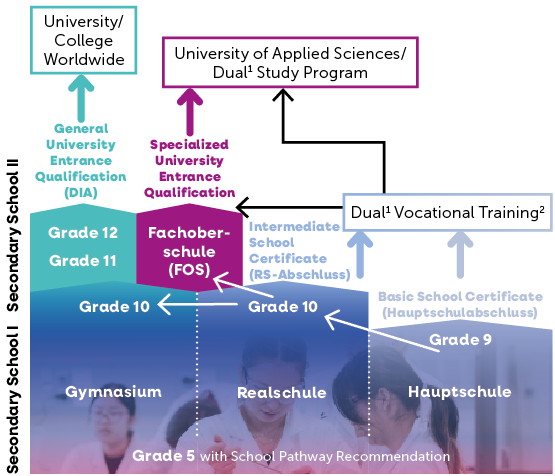
School Stages and Qualifications at DSS

From the Orientation Stage to the German International Abitur

Secondary education at German School Shanghai is divided into two stages and follows an eight-year academic track (G8), with a full-day school programme. Secondary School I covers Years 5 to 10 of the Gymnasium track, Years 6 to 10RS of the Realschule track, and Years 6 to 9 of the Hauptschule track. It prepares students for the upper secondary level. It prepares students for the upper secondary level and begins with a one-year orientation stage, at the end of which an individual recommendation is made regarding each student’s educational pathway. Students can obtain the Hauptschulabschluss (lower secondary school certificate) after Year 9 and the Realschulabschluss (intermediate secondary school certificate) after Year 10.

Secondary School II comprises Years 10 to 12 and includes the introductory and qualification phases of the upper secondary level. Students complete this stage by taking the German International Abitur (DIA), the German university entrance qualification. In addition, our Fachoberschule (FOS), specialising in Business and Administration, offers students who have obtained the Realschulabschluss (intermediate secondary school certificate) the opportunity to earn the Fachhochschulreife (qualification for admission to universities of applied sciences) after two further years of study (Years 11 and 12). Our comprehensive German education programme equips graduates with the skills and qualifications they need to pursue further education and careers in an international environment. Students can also transfer seamlessly into the German school system.

Educational Pathways, Qualifications and Potential Academic and Career Opportunities

Our broad curriculum supports students’ academic and personal development throughout Secondary School, taking into account their individual abilities and needs. Our school-developed curricula are coordinated within the examination region, recognised by the German Standing Conference of the Ministers of Education and Cultural Affairs (KMK), and based on the curriculum of the German state of Thuringia.

Diagram legend:

→ Progression to another stage or transfer to a different pathway is subject to individual criteria.

1 Study or vocational training programmes that combine theoretical learning at a university or vocational school with practical phases in a company.

2 Under certain conditions, students may also pursue higher education after completing vocational training.

An Overview of Our German School-Leaving Qualifications

General Higher Education Entrance Qualification

The German International Abitur (DIA) combines the academic excellence of the German education system with a global perspective. It upholds high academic standards while embracing a modern, open-minded approach to learning. Our students develop a strong foundation of knowledge across a wide range of subjects while building key skills in languages, analytical thinking and intercultural understanding. The DIA is equivalent to the German Allgemeine Hochschulreife and qualifies students to apply to leading universities and higher education institutions in Germany and around the world.

Advanced Technical College Entrance Qualification

Our two-year specialised upper secondary programme (Fachoberschule, FOS) places a strong emphasis on practical learning. Students develop in-depth subject knowledge alongside business skills and international competencies. A long-term work placement in Grade 11, combined with local and international partnerships, gives students valuable insights into a wide range of career paths. The Fachhochschulreife qualifies students to study at German universities of applied sciences and selected other higher education institutions. It also provides an excellent foundation for dual study programmes that combine academic learning with practical work experience.

Lower and Intermediate Secondary School-Leaving Qualifications

Our Hauptschulabschluss and Realschulabschluss provide students with a solid foundation for their next steps in education, both in Germany and internationally. Through differentiated teaching tailored to individual learning needs, we broaden students’ general education while developing practical and career-oriented skills in subjects such as home economics, technology, design and crafts, computer science and business studies. These qualifications open up a range of opportunities, including vocational training, progression to further education and entry into our specialised upper secondary programme (FOS).


Structure of Secondary Education

Grade 5 provides a smooth transition from primary to secondary school and prepares students for the academic demands of the next stage of their education. Teaching follows the Gymnasium curriculum, with differentiated learning opportunities and targeted support to accommodate different ability levels. Individual guidance is central to helping each student find the right path for their continued education. At the end of Grade 5, every student receives an individual recommendation on their future educational pathway, based on academic performance and teachers’ professional assessments.

Lower secondary education covers Grades 6–9 at Hauptschule and Grades 6–10 at Realschule and Gymnasium. Teaching largely follows the Gymnasium curriculum, with learning differentiated to meet students’ individual needs. Up to and including Grade 8, our approach prioritises flexibility between school pathways. This means that students generally study similar content, while assessment is differentiated according to the requirements of their respective school type. Wherever possible, Mathematics and German are taught in ability-based groups. Our aim is to provide an individualised approach to learning methods and strategies through modern teaching approaches and collaborative learning. Transfers between school types are also possible up to the end of Grade 8. In Grades 9 and 10, Realschule students move into separate classes and follow the relevant curriculum, preparing specifically for the official examination for the lower secondary school-leaving qualification at German schools abroad. The examination comprises two written examinations in German, English or Mathematics, as well as an oral examination. The Realschulabschluss is awarded on the basis of examination results and final grades across all subjects taught throughout the school year. Students who achieve an average grade of at least 3.0 in the compulsory subjects on their Grade 10 certificate, including an average of at least 3.0 in German, Mathematics and English, with no grade below satisfactory in any of these three subjects, may transfer to Grade 10 of the Gymnasium upper secondary pathway. Alternatively, the two-year specialised upper secondary programme (Fachoberschule, FOS), with a focus on Business and Administration, offers students the opportunity to obtain the German advanced technical college entrance qualification (Fachhochschulreife). Learn more about the FOS!

Grade 10 also plays a key role in the G8 system. It is not only the final year of lower secondary education but also the introductory year of the Gymnasium upper secondary stage (Sekundarstufe II). Students take centrally set class assessments (Zentrale Klassenarbeiten, ZKA) in German, Mathematics and English. These assessments carry particular weight for students continuing along the Gymnasium pathway.


Foreign Languages and Subject Choices

The standard language sequence for the Gymnasium pathway is English as the first foreign language, followed by French, Latin or Spanish as a second foreign language from Grade 6. Further language options, including Chinese as a local or late-starting foreign language, are available. For further language options, including Chinese as a local language or as a foreign language introduced at a later stage, please refer to our Foreign Languages page and curriculum information for further details. From Grade 6, Realschule students can choose French. Alternatively, they can take practical subjects such as Design and Crafts, Home Economics or Technology. Computer Science and Business Studies are additional options from Grade 9 onwards.


Key Areas of Focus

Our lower secondary programme places particular emphasis on English-language learning opportunities, including bilingual History and Geography taught in English, as well as the sciences. As a school recognised for excellence in STEM education, we place a strong emphasis on science, technology, engineering and mathematics from an early stage. Biology and Computer Science begin in Grade 5, Physics in Grade 6 and Chemistry in Grade 7.

Introductory Phase (Grade 10)

Grade 10 marks the introductory phase of the Gymnasium upper secondary programme. Students who successfully complete the year and take the centrally set assessments in German, Mathematics and English at Gymnasium level may progress to the qualification phase of upper secondary education. Students enrolled in the FOS programme specialising in Business and Administration also have the opportunity to obtain the advanced technical college entrance qualification (Fachhochschulreife) over the following two years.  Find out more about the FOS!


Qualification Phase (Grades 11 and 12)

Grades 11 and 12 form the qualification phase of the Gymnasium upper secondary programme. Teaching is organised into subject courses, with students continuing to receive guidance from a class teacher. Results in all subjects across all four semesters contribute to the final Abitur qualification, in accordance with the regulations governing the German International Abitur (DIA). Students progress through Grades 11 and 12 as a continuous programme, without a separate promotion decision between the two years. The programme concludes with the German International Abitur (DIA) examinations. At the beginning of Grade 12, students select five compulsory examination subjects. Examinations include both written and oral components, as well as a presentation examination. To obtain the DIA, students must complete at least half of their examinations in German.

Questions About Our Secondary School Pathways and Qualifications?

Alongside our school leadership team, our stage coordinators are happy to advise you on all aspects of secondary education at German School Shanghai, including subject choices and our recognised German school-leaving qualifications.

#futurepathways

What have our graduates gone on to do after leaving DSS? Which paths have they chosen, and where are they studying or working today? Our alumni have pursued a wide range of opportunities around the world. We regularly catch up with them to hear about their journeys since leaving DSS, their university experiences, career paths and future ambitions.

Discover More About Our Secondary School

A Wide Range of Subjects and Learning Opportunities

Whether learning languages, conducting research, drawing, making music or taking part in sports, our subject departments combine academic knowledge with the skills to reflect on and apply what students learn. Through a wide range of interdisciplinary projects, students learn to make connections across subjects and think beyond individual disciplines.


Vocational Education Through the FOS

Since 2022, our Hongqiao Campus has offered students the opportunity to obtain the German advanced technical college entrance qualification (Fachhochschulreife) through a further two years of study at our specialised upper secondary programme (Fachoberschule, FOS), focusing on Business and Administration. German School Shanghai is one of only two German schools abroad to offer this pathway.


Guidance on Further Education and Career Choices

Our comprehensive university and career guidance programme helps students prepare for life after school and make informed decisions about their next steps. Through regular projects and events, we support each student in finding the educational or career path that best matches their interests, strengths and ambitions.