Our Educational Approach

Holistic Education – Supporting Every Child’s Individual Development

Our Kindergarten welcomes children from 18 months of age until they start primary school. Their interests and needs are at the heart of our educational approach. We support each child on their individual journey towards independence and prepare them for the transition to German primary school. Our full-day programme offers a wide variety of activities and plenty of opportunities for free play and self-directed learning, guided by the Berlin Education Programme. We also follow the German Central Agency for Schools Abroad (ZfA) quality framework for kindergartens and preschools abroad, which provides important guidance for maintaining high educational standards. Alongside these everyday learning experiences, we integrate targeted support and individual learning opportunities into the daily routine, enabling every child to develop their potential and grow at their own pace.

What Matters to Us

Learning Through Play

Play helps children develop a wide range of skills. Imaginative adventures encourage cognitive development and communication, while everyday play gives children opportunities to practise social skills such as following rules, showing consideration for others and taking responsibility.

Participation

Being able to express their interests and have their opinions heard helps children feel comfortable and valued in our Kindergarten. We therefore provide a variety of opportunities for them to participate in decision-making, both within their own groups and across groups – for example, through children's meetings.

Nature and the Environment

We want to inspire children to explore the natural world and develop an awareness of environmental issues. We spend plenty of time outdoors, incorporate environmental topics into our projects, plant flowers together and take part in litter-picking activities.

Exploring and Creating

Whether painting, crafting or experimenting with different colours, materials and tools, children are encouraged to explore the world around them with all their senses. These hands-on experiences nurture creativity, curiosity and an inventive spirit.

Discovering the World Through Curiosity and Creativity

We encourage children to stay curious and explore the world around them independently. Our project work and dedicated discovery sessions give them plenty of opportunities to follow their interests and investigate new ideas. Whether working with tools, experimenting, making music or building and constructing, children gain new insights through play and begin to understand how learning works. They also have opportunities to shape their daily Kindergarten experience and try things out for themselves. This helps build their confidence and supports their development into independent individuals.

Other Key Aspects of Our Educational Approach

Building Trust and Feeling at Home

At the German School Shanghai Kindergarten, we follow the Berlin settling-in model to help every new child feel safe and secure in their new environment. Close cooperation between our educators and parents or other primary caregivers is essential, as it allows children to build trusting relationships with the educators in their new group.

The settling-in process consists of four phases, during which children are gradually introduced to their new surroundings and the daily routines of our Kindergarten. Before the process begins, we hold an admission meeting with the parents to discuss the child’s individual needs, preferences, dislikes and habits. This enables our team to provide personalised support and help each child settle into Kindergarten life. Initially, parents or another primary caregiver accompany the child in the group. They then gradually withdraw as the child becomes more comfortable. The time spent in the group without their caregiver is extended step by step, allowing children to build a secure relationship with their educators. The settling-in process is considered complete when the child has established a stable relationship with the group’s educators and feels comfortable in the absence of their parents or caregiver. They are relaxed, play, explore their surroundings with curiosity and actively participate in group activities. The process usually takes around four weeks but can be extended if needed.


Transitioning Between Groups

We also ensure that transitions between groups are gradual and supportive. We encourage regular interaction and opportunities for children and educators from different groups and age levels to get to know one another. For example, children can visit the preschool group before moving up and, if interested, take part in selected preschool activities.

We also prepare nursery children for their transition to the regular Kindergarten groups with care. First, their future educators visit them in the familiar nursery environment, giving everyone an opportunity to get to know one another and begin building relationships. The children then visit their new group at scheduled times, gradually gaining confidence and becoming familiar with their new surroundings.

Full-Day Care Options

Our Kindergarten offers a wide range of activities throughout the day for children aged 18 months until they enter preschool. Regular opening hours are Monday to Friday, from 7:45 am to 3:00 pm. Children aged three and above can also take part in fee-based afternoon activities until 5:00 pm. These activities vary by theme, and attendance can be arranged flexibly, including on individual days. The Kindergarten is closed during school holidays.


A Weekly Schedule Tailored to Children’s Developmental Needs

Across all groups, our weekly schedules are designed around the children’s ages and developmental needs. They provide a balanced combination of familiar routines and varied activities, guided by the Berlin Education Programme. 

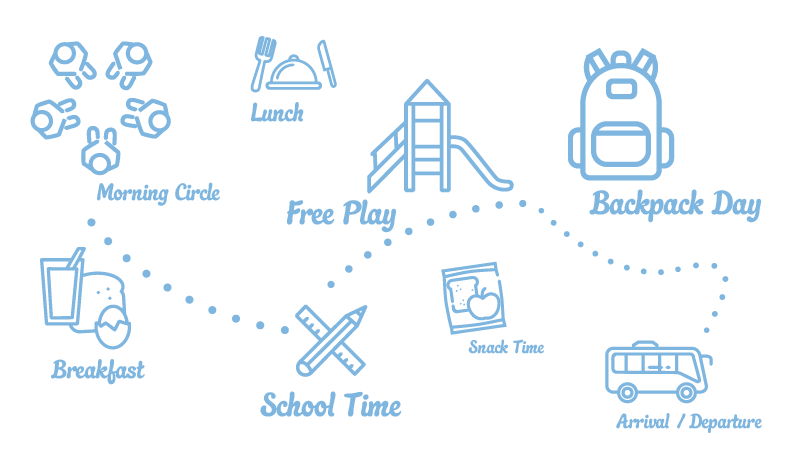
Each day begins with breakfast together and a morning circle in the children’s group. These familiar rituals provide security and orientation while creating opportunities to share ideas and experiences. The rest of the morning follows a thematic focus that recurs regularly and builds on previous learning experiences in a meaningful way. Activities include sports days, library days and the much-loved backpack or excursion day. Each group plans its excursions individually, taking into account current projects, the children’s interests and seasonal topics. Popular destinations include picnics in the park, museums, the zoo, fire stations, dental practices and strawberry-picking trips to farms around Shanghai.

The preschool weekly schedule also includes targeted learning and support activities to prepare children for primary school. In addition, preschool children regularly attend swimming lessons to develop their motor skills, build confidence and become more comfortable and safe in the water.

Our weekly structure provides a well-planned educational framework that offers both orientation and a wide range of learning experiences. Visit "A Day at Our Kindergarten" for a detailed insight into daily life at our Kindergarten.

Regular project work and discovery sessions give children the opportunity to follow their curiosity and explore new ideas. Whether working with tools, taking part in creative projects in the studio or experimenting with colours in the laboratory, children can try new things and bring their own ideas to life. Projects often extend beyond the group room. During gardening sessions, for example, children sow flowers together, while backpack days provide opportunities to explore topics that interest them. A visit to a dental practice might deepen a project on good oral hygiene; a project about marine life might lead to an excursion to the aquarium. Through litter-picking activities on local beaches, children also learn how their own actions can contribute to protecting the environment.

Building a trusting partnership with parents is very important to us. We provide regular opportunities for open dialogue and invite parents to an individual group meeting each year, as well as to an information evening when their child is preparing to transition to preschool. We also keep parents informed about our work with the children every week, sharing detailed insights through our communication channels. For every child, we maintain developmental records in which we document and evaluate our observations, identifying individual strengths and areas where further support may be beneficial. These records form the basis of the two developmental meetings held each year and help us assess each child’s development and individual support needs. We also see parents as important partners in their children’s language development. We share information about their progress and offer practical suggestions for supporting language learning at home. Our Parent Council (Elternbeirat, EBR) serves as an important voice for the parent community. It facilitates the exchange of information, represents parents’ interests, supports everyday life at the school and Kindergarten, and promotes structured dialogue between parents, school and Kindergarten leadership, and the administration.

At our Kindergarten, we see diversity as an asset. Different countries, traditions and cultural characteristics are deliberately incorporated into everyday activities. The intercultural community of children, parents and educators from diverse backgrounds further encourages understanding and appreciation of other cultures. Experiencing both Chinese and German culture gives children a particularly valuable opportunity to develop an open-minded outlook and intercultural competence. We encourage everyone to participate actively and promote exchange throughout the school community. This sense of community strengthens relationships and supports children’s social development. Alongside German traditions, we celebrate Chinese festivals such as the Mid-Autumn Festival and Chinese New Year, bringing intercultural exchange to life. One annual highlight is China Day, when children explore Chinese culture through hands-on activities at different stations, including making jiaozi, practising calligraphy, and enjoying music and theatre performances.

A successful start to school begins with thoughtful preparation and support throughout a child’s final year at Kindergarten. Our “Ready for School” programme includes two structured learning sessions each week for preschool children, complementing their regular group activities. The aim is to strengthen independence and organisational skills while developing the abilities needed for primary school. These include the fine motor skills required for writing and cutting, as well as sorting, organising and structuring as foundations for mathematical learning. Children also practise skills essential for reading and writing, alongside attention and concentration. Each preschool group also partners with a Year 1 primary school class. Through shared activities and excursions, the children can exchange experiences and gain insights into school life. A treasure hunt across the entire campus is another part of the programme. It allows children to discover their future school environment before their first day and even take a peek inside the primary school staff room. Shortly before the summer holidays, the children celebrate their big farewell from Kindergarten. After looking back on their time with us through a lovingly prepared review, the moment arrives: their educators give them a playful, symbolic send-off into primary school – quite literally helping them make the leap, safely, into their next chapter. After the summer holidays, the children return for the exciting next step: starting primary school.

Language Support and Foreign Language Learning in Kindergarten

German language support begins in our youngest groups. Our tailored language programmes help children with little or no prior knowledge of German develop the skills they need to participate confidently in everyday Kindergarten life and prepare for the transition to primary school. Our comprehensive language development concept further expands these opportunities. From the regular Kindergarten groups onwards, children can also begin learning English and/or Chinese through play.

A Day at Our Kindergarten

What happens during a German or Chinese morning circle? What are discovery and project sessions? And what does a typical day at the German School Shanghai Kindergarten look like? Our Kindergarten children help us answer these questions and give you a glimpse into their daily lives. Take a look inside!

Deutsche Schule Shanghai

Interested in DSS? Get in touch or book a campus tour.

Contact Us Now

More About Our Kindergarten

A Smooth Transition to Primary School

We prepare children carefully and purposefully for the transition from preschool to primary school. Each preschool group works closely with a partner class in Year 1. Through joint projects, excursions and shared reading sessions, children build confidence and develop a sense of curiosity about school life and learning.

Meet Our Kindergarten Team

Our dedicated team supports around 160 children aged 18 months and above at two locations in Shanghai every day. German- and Chinese-speaking educators, language support specialists, special education professionals and external experts work closely together to provide individual support and guide each child’s development.