


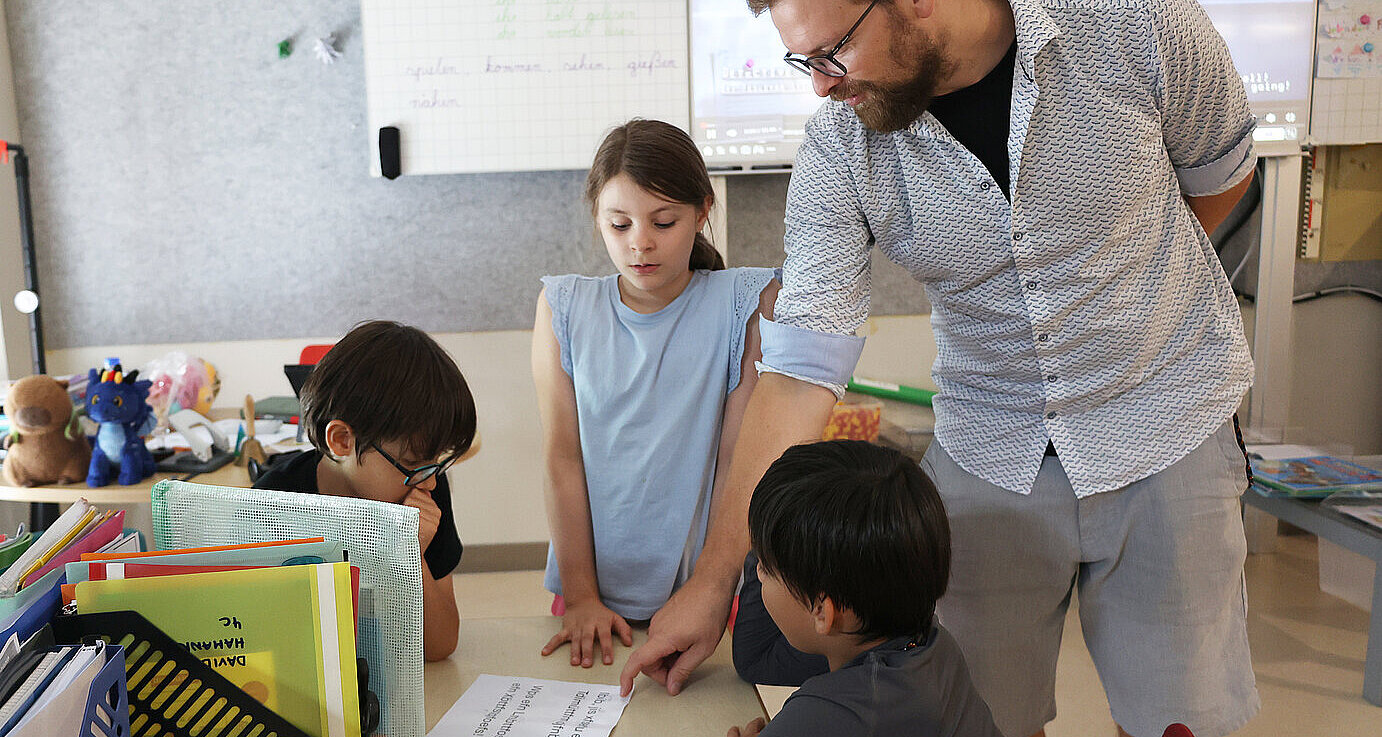

Our Eurocampus locations in Shanghai offer a unique intercultural learning environment in one of the world’s most dynamic cities.
Learning Languages from the Very Beginning
As a German school in China, sharing the Eurocampus with the French school, we are a place where multilingualism and cultural diversity are part of everyday life. German is our language of instruction, but our approach to language development extends far beyond the classroom. From the start of kindergarten through to graduation, we support our students in developing their language skills in an international environment. For children who have little or no German and need additional support to follow lessons with confidence, our German as a Foreign Language (DaF) and German as a Second Language (DaZ) programmes provide a structured pathway to learning and strengthening their German skills from the very beginning.
Language Development from the Start of Kindergarten
Kindergarten
Children discover the world through language. German is at the heart of everyday life in our kindergarten, where children are supported by German-speaking early years professionals. From the age of four, they are also introduced to English and/or Chinese through playful activities led by native speakers.
Primary school
In primary school, students benefit from a differentiated English programme, including the opportunity to take the Cambridge Young Learners English Tests, as well as Chinese lessons. Additional projects, extracurricular activities and atelier sessions provide further opportunities to develop language skills.
Secondary School
As students progress through secondary school, they can expand their language repertoire with French, Spanish or Latin, alongside bilingual subject teaching or Chinese. Targeted preparation for recognised language certificates and opportunities to develop language skills beyond the classroom further enhance the programme.
Language-Sensitive Teaching
Language-sensitive teaching is an integral part of our approach. Our teachers use language as an active tool for learning, explaining subject content clearly, using accessible language and systematically building vocabulary through our ‘German in Subject Teaching (DFU)’ approach. This helps students develop their language skills alongside their subject knowledge, enabling them to participate actively and confidently in lessons, understand complex concepts and express themselves precisely.
Since 2008, the German School Shanghai has been an official examination centre for Cambridge English qualifications. Our team offers preparation courses as part of the extracurricular programme from primary school onwards, helping students prepare for internationally recognised qualifications at their individual level – from Cambridge English Young Learners to C2 Proficiency.
As part of our Chinese language programme, we also prepare students for the HSK examinations, which can be taken at external examination centres in Shanghai. HSK certificates provide officially recognised proof of Chinese language proficiency and can, for example, support applications to Chinese universities and international programmes.
Since 2025, we have been an approved examination centre for the Spanish DELE diplomas at A1 and A2/B1 escolar levels. Awarded under the authority of Spain's Ministry of Education, these certificates confirm language proficiency in accordance with the Common European Framework of Reference for Languages (CEFR). They can open up opportunities for scholarships, further education and careers in more than 100 countries.
Since 2012, the German School Shanghai has been a certified CertiLingua school. We award this prestigious label to students who demonstrate outstanding proficiency in two foreign languages, experience in bilingual subject learning, and European and international competence. Awarded alongside the German Abitur certificate, the label can facilitate access to international degree programmes and broaden career opportunities in a global working environment.
Through the Lycée Français de Shanghai on the shared Eurocampus, students also have the opportunity to take the DELF examination. The DELF (Diplôme d’Études en Langue Française) is an internationally recognised French language qualification that provides official proof of French proficiency and can, for example, support applications to universities. The examination assesses all four language skills and is available at different proficiency levels.
We’re Learning German!
German language skills are the foundation for a successful education at the German School Shanghai and a prerequisite for obtaining a German school-leaving qualification. Through our German as a Foreign Language (DaF) and German as a Second Language (DaZ) programmes, children with little or no prior knowledge of German can also join our school and take an active part in school life. Our experienced, professionally trained team provides sensitive, expert support, guiding each child along their individual path towards learning German. In our kindergarten, the DaF/DaZ programme is offered free of charge, combining early language support with particularly attractive conditions for families.
German as a Foreign Language (DaF)
Our DaF programme helps kindergarten children and primary school students with little or no prior knowledge of German make a confident start in school life. The aim is to build their language skills and enable them to participate fully in learning, cultural activities and the wider school community from the very beginning.
Tailored Language Support
An assessment of each child’s language skills helps us determine whether DaF support is needed. If so, participation in the programme is compulsory, ensuring that each child receives the support they need to develop their German. We regularly assess progress and adapt teaching and individual support to meet each child’s changing needs.
Learning Together
From day one, children in the DaF programme are part of a regular kindergarten group or primary school class. In addition to their regular classes, they receive intensive support in small DaF groups, as well as targeted language support in kindergarten or during mainstream lessons.
Building Language Skills
From Year 1 onwards, children receive 10 to 15 hours of DaF lessons per week in small, mixed-age groups. These lessons develop essential language skills and prepare children to learn other subjects in German, helping them transition confidently and step by step into mainstream classes.
Achieving Language Goals
The length of participation depends on each child’s individual language development. The DaF programme is designed to last up to three years and aims to bring students to B1 level under the Common European Framework of Reference for Languages (CEFR). Once they reach this level, they move on to our German as a Second Language (DaZ) programme.
German as a Second Language (DaZ)
Our DaZ programme supports children and young people who already have some knowledge of German but need additional help in specific areas. The aim is to strengthen their language skills so they can follow lessons taught in German across all subjects with confidence and take an active part in school life. A language assessment helps us determine whether a child needs DaZ support. If so, participation in the programme is compulsory. Support is available from the first year of kindergarten and, where needed, continues through Year 9.
Monitoring Language Development
To track each child’s progress and tailor support to their needs, we conduct regular language assessments. These show which skills children have already mastered and where further support would be beneficial. The results form the basis of individual learning plans and help us continually reassess each child’s support needs.
Strengthening Language Skills
DaZ lessons focus on listening comprehension, communication, vocabulary and grammar. From Year 1 onwards, reading comprehension and written expression are also included. Support is tailored to each child’s individual needs, providing consistent guidance as their language skills develop.
Integrated into the School Day
In primary and secondary school, DaZ lessons are part of the regular timetable and take place during personalised learning and practice sessions, such as extracurricular activity periods or study sessions. In kindergarten, language support is closely integrated into everyday group activities, encouraging children to develop their German through daily interaction.
Support Tailored to Individual Needs
The amount of DaZ support each child receives depends on their individual needs. The fee-paying support period is limited to a maximum of three years. The programme comprises three levels – BASIS, MEDIUM and MAXIMUM – guiding children step by step until they can follow lessons with confidence and without language barriers.